

Connor Macbeth
How the one Shakespearean tragedy you read in high school aligns with the Edmonton Oilers -- and their uncertain path ahead.

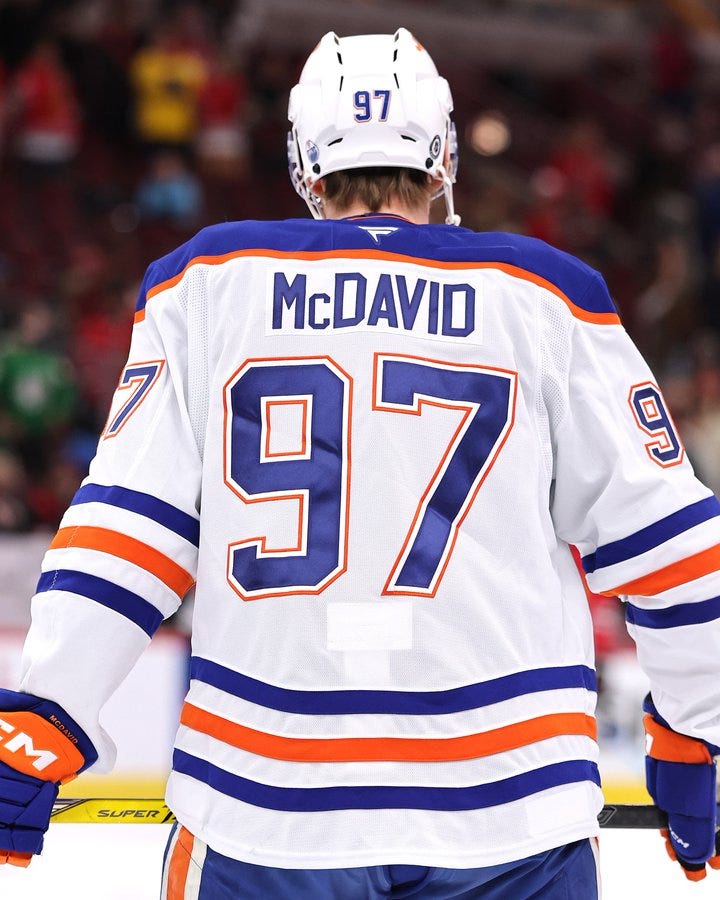
“We were an average team all year. When you're an average team with high expectations, you're going to be disappointed.”
Connor McDavid’s words to the media after the Edmonton Oilers faced a stunning defeat to the Anaheim Ducks in Round 1 of the Stanley Cup playoff, a far cry from the team in 2024 that wrangled the Florida Panthers to seven games in the Stanley Cup Final; rang as a harsh warning — to the Edmonton front office, particularly general manager Stan Bowman, to the team itself, but mostly, to himself.
McDavid’s performance was so deeply unlike the man who earned the nickname “McJesus” before he was even drafted into the NHL in 2015. In six games, playing on a ankle/foot fracture, he had one goal and five assists — a measly six points — and a -8 rating. A far cry from the man who earned the Conn Smythe in 2024, despite not being a part of the winning team. A far cry from the playmaker the world has witnessed from his Erie Otters days, a man several steps ahead of everyone else.
PROPHECIES AND CURSES
In the real world, there are no “Weird Sisters” lurking in the background, ready to “Hover through the fog and filthy air”, creating strange curses for the men of Scotland.
However, in the hockey world, there are the Hockey Gods, who might as well be the same thing. The Hockey Gods have no gender, no race, no class. They are one of the few things that bring hockey fans across the world together, setting aside differences for the sake of superstition. Even those inside believe. Tampa Bay Lightning coach — and McDavid’s Team Canada coach — Jon Cooper, told reporters after the Lightning’s first round elimination, “That’s when you – at the end of the game, and you’re just sitting there saying, ‘The, the hockey gods have been in my corner many, many times, and tonight they’re in the other corner.’ And that’s what happens.’”

McDavid’s idol, Cole Harbour’s Sidney Crosby, is the same way. A man of superstition, a man who finds hockey home — to the extent of removing his shoes in the Pittsburgh Penguins locker room. A man of fate, a man of destiny.
Before McDavid, there was Crosby, and before him, there was Alexandre Daigle; there was Gretzky and Lemieux. Bryan Fogarty before them, Bobby Orr before him, and countless other men who were once boys, whose paths were intertwined with raw talent, work ethic, and promises of hockey glory.
A MAN OF DESTINY
“But all’s too weak;
For brave Macbeth (well he deserves that name),
Disdaining Fortune, with his brandished steel,
Which smoked with bloody execution,
Like Valor’s minion, carved out his passage…”
From the moment a toddler Connor McDavid let go of his father’s hand in an ice rink, the world was his.
Since he first began playing hockey at the age of three, on rollerblades in the family basement in Newmarket, Ontario, he was deemed as gifted, as a prodigy, as someone special. The next year, at the age of four, he begged his parents to play hockey a year early. They lied about his age so he could.
By six, McDavid’s parents attempted to enroll him in a league with seven-year-olds in Newmarket, but were denied.
In a 2013 profile of McDavid from The New York Times, journalist Tim Rohan described the child as, “At 5, he wore a nice shirt and tie to every one of his older brother’s games, just like the players. He listened to the pregame speech in the locker room, sat in the stands next to his mother and explained, in precise detail, any moment she missed while chatting with the other mothers, as the other brothers were off lollygagging.
At 12, he dominated his father’s Sunday pickup games, weaving through a forest of adults, ducking under arms, passing through legs, scoring for fun.” 1
One of the best-known McDavid anecdotes came from his mother, Kelly, in an interview lost to time. The story remains the same — McDavid asked to write to Crosby to ask how he deals with the pressure.
Crosby was fifteen.
McDavid was five.
Rarely do we — as a sports world — witness someone who exists completely for their sport. Hockey is different. A sport that is mental just as much as it is physical. In order to succeed, one has to be meticulous. Repetitive. Calculated.
Or, as McDavid’s mother puts it — “a thinker.” 2
Connor McDavid is the exception. Years before the 2015 NHL Draft, where we witnessed him walk onstage in Sunrise, Florida, years before he put on the orange Edmonton Oilers jersey and blue hat, years before his first 11 million dollar contract, years before he became the youngest captain in NHL history at the age of nineteen and the youngest Art Ross Trophy since Crosby did so in 2007 (at the age of nineteen), before ending the Oilers playoff drought in 2017, before more money, more failed playoff chances, before the trips and subsequent losses in the Stanley Cup Final — there was always that drive and ambition in a young McDavid that very few players, much less people, have.
Young hockey players tend to gain international attention in two ways: the NCAA cycle, or the junior hockey cycle. Unlike later stars like San Jose’s Macklin Celebrini, in the early 2010s, McDavid chose the junior hockey route. Traditionally, these players are sixteen years old when drafted to a junior team.
McDavid applied for exceptional player status through Hockey Canada, and was only the third OHL (Ontario Hockey League) player to be granted said exception — the other two were John Tavares and Aaron Ekblad. From there, things were on an upswing — on April 7, 2012, McDavid was drafted first overall to the Erie Otters in the OHL Priority Selection, signing his first contract with the Otters in June 2012.
As Lin-Manuel Miranda wrote, “Legacy? What is a legacy? It’s planting seeds in a garden you’ll never see.” In three years with the Otters, McDavid established a legacy — being a major contributor in taking them from the bottom of the OHL to the top. Becoming the youngest OHL player to be a part of events like the Subway Super Series. Taking home endless individual awards. And most of all, becoming captain of the Otters, leading to other captaincies in prospect events, such as The CHL/NHL Prospects Game in 2015. By the end, McDavid had 285 points — 188 of them assists, leading the franchise history books.
He finished his junior career as the most decorated player in OHL history.
A KING WITHOUT A CROWN
“When I burned in desire to question them further, they
made themselves air, into which they vanished.
Whiles I stood rapt in the wonder of it came missives
from the King, who all-hailed me ‘Thane of Cawdor,’
by which title, before, these Weird Sisters saluted me
and referred me to the coming on of time with ‘Hail,
king that shalt be.’ This have I thought good to deliver
thee, my dearest partner of greatness, that thou
might’st not lose the dues of rejoicing by being ignorant
of what greatness is promised thee.”
In those three years with the Otters, there was one thing McDavid never was able to accomplish — win a title.
The Otters made it to the Robertson Cup Final in 2015, but lost to the Oshawa Generals in five games. Oshawa forward Cole Cassels told media after the game, “Words can’t describe how proud I am of our team. We shut down Connor McDavid and the Erie Otters, which isn’t easy.” 3
Despite this, McDavid was a highly toted prospect, a young man with endless potential. The 2015 NHL Draft lottery was not one to be missed. It was the Crosby Sweepstakes all over again, except this time around, it was during a much more digitalized era. It was much easier to react to news through YouTube and Twitter, at the Internet’s possible peak. Just like Macbeth himself, the world had their eyes on McDavid.
With the luck of the hockey gods, the luck of a few ping-pong balls, the young hero’s journey officially began in Edmonton, Alberta, as Oilers fans across the province celebrated. Crowds rose to their feet and cheered for the hope of a young man coming to save their beloved franchise.
Since the days of Wayne Gretzky and Mark Messier, the Oilers had been on a downturn, with their record being something more than abysmal in 2015, 24–44–14. Despite making the Stanley Cup Final in 2006 with stars like Chris Pronger, the team didn’t see much success afterwards. They’d drafted Taylor Hall at first overall in 2010, and again in 2011 with Ryan Nugent-Hopkins, and yet, it was never enough to push them into the playoffs. To see any meaningful success. Hall would be traded to the New Jersey Devils in exchange for Adam Larsson in June 2016, goaltender Cam Talbot would be traded from the New York Rangers to go to Edmonton in the summer of 2015; and general manager and coaching changes were made — all to build around a new, young core, led by one of the best hockey players in the world.
That player, McDavid, would become the youngest captain ever in the history of the National Hockey League at the age of nineteen years and two-hundred-and-sixty-six days.
He would later write about the experience to The Player’s Tribune, nearly a decade later: “I had one thought when I became captain of the Oilers.
Obviously, when you’re given the C at 19, there’s a million things that go through your mind. You start wondering if you can grow a beard. You start thinking about your suits. But the one thing I kept thinking was....
Man, I really gotta move out of my parents’ house now.
I’m supposed to be the leader of a room with all these grown men who have two or three kids. How are they supposed to listen to me when I get back home at night and my mom is like, ‘Hey. Tough game. I washed your sheets.’
I wanted to be the captain of the Edmonton Oilers. I wanted that pressure. No doubt. But I’d be lying if I said it came naturally to me, or that the weight of it wasn’t heavy.”4
Despite the Oilers’ internal turmoil, McDavid lived up to expectations almost immediately. He only appeared in 45 games his rookie season due to a fractured left clavicle in his thirteenth NHL game, but finished fourth in rookie scoring — sixteen goals and thirty-two assists, third-place in Calder Trophy votes. In his sophomore season, he reached 100 points in 92 games played. As more time passed, the young man who shaped so much of his game after his idol, Sidney Crosby, the original boy king — began to shape history of his own, a king in his own right. At twenty years old, McDavid won the Art Ross Trophy for the NHL’s scoring leader — in total, he racked up 100 points.
In 2017, McDavid’s junior season, the Oilers snapped their decade-long playoff drought. Despite being eliminated in the second round in seven games, he proved himself to be a bona-fide playoff performer alongside close friend and teammate Leon Draisaitl — a young player drafted at third overall in 2014, the year before McDavid, equally as ambitious, the Lady Macbeth to McDavid’s Macbeth (despite not facing any of the former’s specific gender-induced internal conflict). McDavid, just like in the OHL, became a decorated individual player, winning awards like the Ted Lindsay for the most outstanding NHL player chosen by the NHL’s Player Association (or the NHLPA, for simplicity’s sake), the Hart Memorial Trophy, the Art Ross again.
But there was still something missing.
McDavid wanted to win.
And he wanted to win with the team that chose him.
On July 5, 2017, four days after the official opening of free agency, McDavid signed an eight-year, $100 million USD extension in Edmonton.
Despite this, the Oilers kept losing. They kept failing to build around their two young stars. The days grew darker, with McDavid suffering more injuries. And in 2019, the Oilers underwent more internal changes, particularly at the general manager position.
All of this occurred before McDavid’s twenty-third birthday. At the same time, McDavid reached 400 NHL points in 306 games.
In 2021, the Oilers went more changes, this time, at coaching, due to a lack of depth. The new goal — support their two stars as much as possible. They were a playoff team in the bubble, but consistently found themselves dropping in and out of a playoff spot.
And yet, McDavid kept climbing. He won more individual trophies. He sent the Oilers to the Western Conference Final in 2022, scoring 10 goals and 33 assists, leading everyone else in scoring for the entire postseason. In 2023, he sent the Oilers back to the WCF, falling to the Stanley Cup champions of the Vegas Golden Knights. He knew what he — and a new Oilers — could do, dubbing the 2023-2024 season as “Cup or bust.”
It began disastrously. The Oilers had a 3-9-1 record. McDavid missed games due to injury. Then the Oilers fired head coach Jay Woodcroft, and hired McDavid’s former Otters coach, Kris Knoblauch.
That hiring changed the course of the Oilers. McDavid had 100 assists and 32 goals that season, and continued it in the postseason. After losing the first three games of the Cup Final to the Florida Panthers, McDavid scored four points in Games 5 and 6, and lost in seven for Florida’s first ever Cup win. Despite winning the Conn Smythe, McDavid did not leave the locker room to accept the award. In Amazon Prime’s documentary, Faceoff, McDavid told filmmakers,“We lost in the most heartbreaking way. It was a moment that I will never forget ever. I wouldn’t have gone out there for a million dollars.”
History repeated itself in 2025, despite McDavid rocking the world with his overtime goal in the Four Nations Tournament, sending Canada to victory in a time where political tensions had never been higher with its neighbors to the south.
Nearly two years later, McDavid is in the same position. A man who has almost everything he’s ever wanted… except the one thing destiny seems to never let him grasp.
THE WORLD WILL NEVER BE THE SAME
“Accursèd be that tongue that tells me so,
For it hath cowed my better part of man!
And be these juggling fiends no more believed
That palter with us in a double sense,
That keep the word of promise to our ear
And break it to our hope.”
2026 has been one of the most tumultuous eras of McDavid’s career. Between the Oilers’ poor performances in both the regular season, and the heartbreak of losing to Team USA in Milan’s gold medal game in overtime, despite being named the Olympic MVP, hockey’s most ambitious man faces an uncertain path ahead. Oilers general manager Stan Bowman has been insistent that nothing is wrong. His two top stars, his Macbeth and Lady Macbeth, tell a different story.
What he will do after his two-year extension expires is an open-ended question that no one — maybe not even McDavid himself — knows what else to do. While the Shakespeare play ends in tragedy, the story of the Oilers looks to end in a similar manner (without the murder and madness).
As McDavid himself said,
“I never felt pressure, or like I had to be somebody.
I was just discovering who I was and who I wanted to be. And I think somewhere along the way, shooting pucks into the plywood of our garage and making long drives for games, I realized that I just wanted to be the best version of myself — to see what I could become. I knew, in hockey, it meant that you have to win. Because I know what it means to win, and what it means if you don’t. So I’ve wanted to win my whole life. It’s who I am.”5
Rothan, Tim. “A Prodigy On The Way to Stardom.” The New York Times. https://web.archive.org/web/20220205174637/https://www.nytimes.com/2013/02/18/sports/hockey/connor-mcdavid-excels-in-ontario-hockey-league-and-is-on-way-to-stardom.html?pagewanted=1&_r=2&seid=auto&smid=tw-nytimessports
Klinkenberg, Marty. “Family Ties: While his father helped develop Connor McDavid’s hockey skill, it was his mother who nurtured his heart.” The Globe and Mail. https://web.archive.org/web/20220205174637/https://www.theglobeandmail.com/sports/hockey/family-ties-while-his-father-helped-develop-connor-mcdavids-hockey-skills-it-was-his-mother-who-nurtured-his-heart/article26423586/
Ontario Hockey League. “Oshawa Generals win Robertson Cup.” Ontario Hockey League. https://web.archive.org/web/20220206210127/https://ontariohockeyleague.com/oshawa-generals-win-robertson-cup/
McDavid, Connor. “Dear Canada.” The Player’s Tribune. https://www.theplayerstribune.com/connor-mcdavid-nhl-hockey-canada-edmonton-oilers
McDavid.